NOTHING FOLLOWS ITS SPONTANEOUS COURSE
Curated by Sihan Tara Chen
Hosted by Mona Kim
Opening Reception: May 15, 2026 6-9 pm
On view: May 16 - June 3, 2026
Maison Mono 150 Bayard St
Store 1
Brooklyn, NY
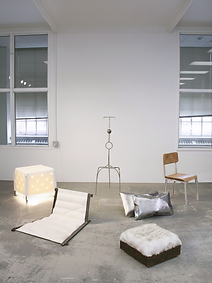
Nothing Follows its Spontaneous Course presents the works of nine emerging designers and artists in their NYC x Design debut.
.png)


presence-eternity, Steel, Bronze, Cherry Wood, 22" x 32" x 21", Sihan (Tara) Chen,
'Niyam' Chair, Rice, Steel, Hardware, Wool, 2025, PUR
i want to feel small in a house that feels infinite, Mild Steel,
22”x18”x30”, Meri Sanders, 2024
Nothing Follows its Spontaneous Course features works by Axel Anderson, Ankita Bhat, Sihan Tara Chen, Greg Kmieciak, Zoe Maxwell, Olivia Moon, Maggie McCreery, Meri Sanders, and Xinchun Xie all utilizing the furniture object as a stabilizing agent within the increasingly dissonant landscape of the contemporary home. The exhibition proceeds from the premise that domestic space, once imagined as the hearth of intimacy and dwelling, has been reshaped by the pressures of mechanization, material excess, and technological mediation.
Today, the home emerges as a site of psychological contradiction: a place where apparatuses simulate labor and care, interfaces eclipse personal encounters, and previously charged surfaces lose the residue of lived experience. This condition echoes what cultural historian Daniel Czitrom identifies as “modern nervousness,” a phrase originally used to describe the psychic turbulence accompanying nineteenth-century industrialization. Under present circumstances, this nervousness is renewed through algorithms, systems, and devices that contour everyday life and subtly recast the ontology of the domestic.
The artists in this exhibition respond to this tension through material experimentation and conceptual
disobedience. Their works stretch recognizable forms past the threshold of utility, transforming chairs,
textiles, and architectural fragments into objects that resist conventional expectations. Through material culture, process-based making, or deliberate impracticality, the objects destabilize the visual and functional grammar of the domestic. These gestures—spanning installation, textile processes, woodworking, and metal fabrication—compose a collective critique of how the aesthetics of the home have been shaped by efficiency, convenience, and the optimization fantasies embedded in contemporary life.
In Nothing Follows its Spontaneous Course, the gallery becomes a zone of feral domesticity: a space where objects misbehave, systems loosen, and the familiar mutates into the uncanny. By altering the viewer’s sense of comfort and utility, the exhibition makes visible the precariousness of bodily presence within its own environments. Ultimately, it asks: How can we regain the forms of vulnerability, agency, and relationality that are sacrificed when the home is reorganized around automation and optimized systems? What remains of the human when the domestic sphere is no longer a sanctuary but a mechanism?

Fixed Point, Mild Steel, 16" x 20" x 50", 2025


Metal Pillows, Steel, Various Dimensions, Sihan
(Tara) Chen, 2025
11011 BPM, Aluminum, LED, Textile, Foam, Selina Xie and Dora Soong, 2024, PUR
Sihan Tara Chen
Sihan Tara Chen is an independent curator and artist from Shenzhen, China, currently based in
Providence, RI. Their practice is informed by a belief in object-person relationality, that when our
sloughed skin meets the aging flesh of all our objects, for as long as we are gentle, it is gentle back.
Rooted in ritualistic assemblage which relies on intuitive reactions to unpredictable processes, such as
patination, Sihan works to imbue all their works with this sense of memory and kinship.
Instagram Website
Axel Anderson
Axel Anderson works primarily in acrylics, experimenting with oils and unconventional techniques to
create textured, non-representational pieces that invite emotion and curiosity. Influenced by Willem de
Kooning and his father, who taught Axel to paint, his work is a personal outlet, translating thoughts and
emotions into physical form. Axel aims to create art that resonates with viewers on an intuitive level,
offering space for their own interpretations.
Instagram Website
Ankita Bhat
Ankita Bhat is a Singaporean-Indian designer whose work explores the beauty of cultural diaspora and
intergenerational experience, drawing motifs and rituals from her maternal history and lineage to invite
those who view her work to slow down, ask questions, and share a private experience with her through
her objects. She takes the time to critically investigate her past through her writing practice while
engaging in deep material research to come up with linguistic considerations for her work as well as the
development of colors, stains, and composites. Currently, Ankita is working towards a BFA’26 in
Furniture Design at the Rhode Island School of Design.
Instagram Website
Greg Kmieciak
Greg Kmieciak is a metalworker and furniture maker based in Providence, RI. With a background in
fabrication, restoration, and small-scale production, his work is driven by a long-standing interest in
making, problem-solving, and material experimentation. He primarily works with steel, bronze, and
silver, often using labor-intensive processes to elevate materials typically associated with industry or
everyday use. His objects tend to look familiar at first—a table, a light, a utensil—but reveal themselves
through unconventional forms, visible process, and attention to detail. Currently an MFA candidate in
Furniture Design at RISD, he approaches making as a way to think through labor, value, and personal
experience.
Zoe Maxwell
Zoe Maxwell is a multidisciplinary maker born and raised in Burlington, Vermont. She creates functional
yet playful objects that celebrate traditional craft techniques as material translations of care and comfort.
Through her work, she seeks to reinterpret and challenge conventional expectations of familiar objects
and spaces. Zoe is currently pursuing a BFA in Furniture Design at the Rhode Island School of Design,
class of 2026.
Instagram Website
Olivia Moon
Olivia Moon is a sculptor exploring the relationship between nature and nurture, parasitic bonds, and out
of body experiences through a blend of paintings and structural work. Olivia seeks continuity, an
invitation for interaction and reflection, to honor time and place and to evoke the quiet presence of objects
in our lives.
Instagram Website
Maggie McCreery
Maggie McCreery is a furniture maker and regenerative farmer from Portland, Oregon whose work exists
to foster compassion towards not only the human form, but the under-recognized personhood of materials.
McCreery crafts domestic objects as accessible educational resources that cultivate connections between
people and the material systems we are all dependent on. Their work and research highlights connections
between the intimate scale of relationships and global systems of material trade in order to engage
audiences in conversations of interdependency and kinship.
Instagram Website
Meri Sanders
Meri Sanders, an interdisciplinary maker from the San Francisco Bay Area with a focus on textiles.
Reflecting on their relationship to the world from a young age, their work aims to bring people into spaces
rooted in whimsy and care. Meri is interested in how textile practices among others can lend themselves
to being teaching tools and how collected data and stories can be translated into new forms.
Instagram Website
Xinchun Xie
Xinchun ( Selina) Xie is a multidisciplinary designer who aims to transform functional objects into
mediums for exploring human emotions, relationships, and societal constructs. Each piece invites viewers
to engage with deeper questions about life, culture, and existence. She works to refine furniture as a
bridge between art, thought, and material innovation. Xinchun’s current exploration examines the
hospital’s role as both a place of healing and an instrument of depersonalization, these works invites
viewers to reflect on how technology mediates our understanding of the body and its connection to
individuality and care.
Instagram Website